
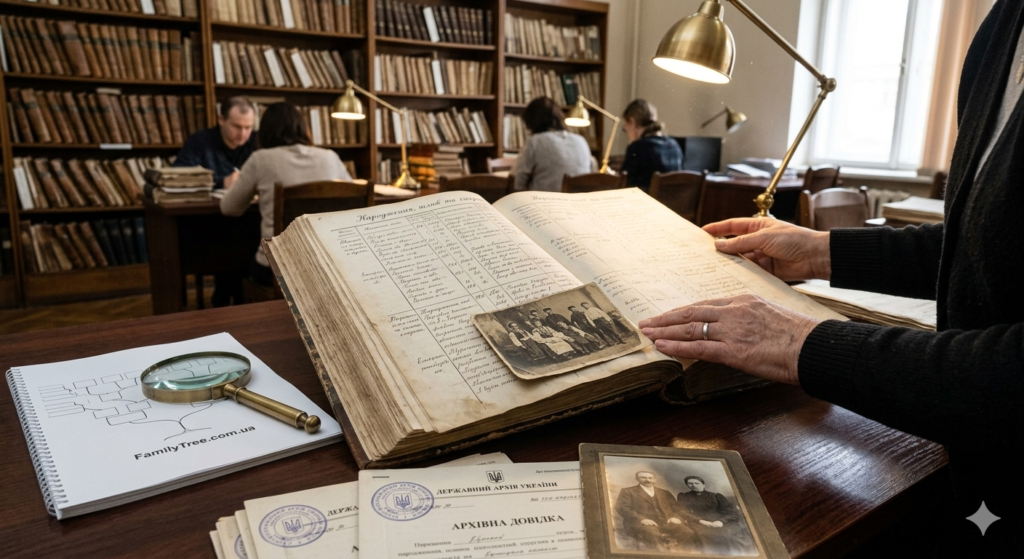
Searching for ancestors is not just a collection of names, but a real detective investigation. For a family tree to be sustainable, it must be based on facts, not assumptions. We have prepared a step-by-step guide on how to lay the right foundation for your family tree.
Home archive: "revision" of memory
Before you go to government offices, look in your family's filing cabinets. Your goal is to find any documents issued before 1991.
- Birth, marriage, and death certificates: These are the keys to future generations.
- Military IDs and Employment Records: These often contain records of birthplace and relocations.
- Old photos: Pay attention to the captions on the back — they often contain dates, names, or the name of the photo studio (this narrows down the geography of the search).
Interview with relatives
Record conversations with the oldest family members. Ask not only about names, but also about everyday details:
- What church did they go to? (This will determine which birth records to look for.).
- Were they repressed or dispossessed? (This opens access to investigative files in the archives of the SBU or the Ministry of Internal Affairs).
- Where did they work or serve?
Definition of geography and religion
In the archives, documents are organized by territory. You need to know the name of the settlement and the county (district) it belonged to at the time of the event.
Importantly: Regional borders and village names changed frequently. A professional genealogist always checks the administrative-territorial division of the relevant era.
Work with civil registry offices (events after 1945)
Documents from the last 75 years are usually stored in the registry office. To obtain an extract, you need to confirm direct kinship with the person. This is the first stage of legal verification of your tree.
Access to state archives (events before 1921-1945)
When you reach the generations born at the beginning of the 20th century, the search moves to the State Archives. The main sources here are:
- Metrical books: Records of baptisms, weddings, and funerals.
- Confessional rolls: Lists of parishioners, which indicate the composition of the entire family with the age of each member.
- Reviz Tales: Population censuses for taxation (relevant for searches in the 18th-19th centuries).
Why is it worth contacting specialists at the start?
Independent searching can take years due to lack of experience working with paleography (ancient writing) or the closure of certain funds.
FamilyTree.com.ua helps you avoid common mistakes:
- Accurate identification: We distinguish namesakes from real ancestors.
- Access to funds: We work with archives throughout Ukraine and abroad.
- Legal purity: Each entry in your tree will be confirmed by an archival certificate with a code (fund, description, case).
Building a family tree is a tribute to those who gave us life. Start your journey today.
Need help with your professional search? Leave a request on the FamilyTree.com.ua website for a detailed analysis of your family line.